eCommerce WordPress Themes

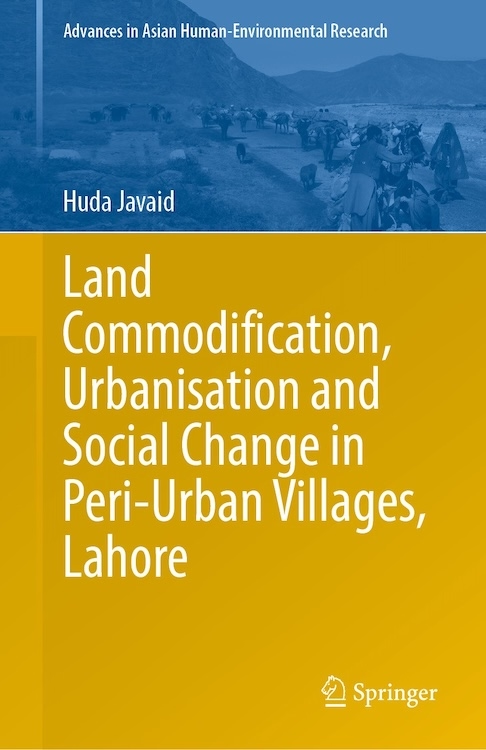
Land Commodification, Urbanisation and Social Change in Peri-Urban Villages, Lahore

ISBN

Publisher

Imprint

Year Published

Print Length

Format

SKU

9783032104618
Springer
N/A
2026
202 pages
Paperback
2665

Original price was: ₨47,995.00.Current price is: ₨1,995.00.

Description

Peri-urban villages on the fringes of Lahore are undergoing rapid socio-ecological
transformation as agricultural landscapes give way to speculative real-estate development and expanding concrete frontiers. While similar processes are unfolding
across the Global South, with parallels in parts of Latin America and Africa, a rich
body of scholarship has examined these transformations through lenses, such as
displacement, dispossession, urban inequality, informality, gentrification, land
acquisition, infrastructure provision, environmental degradation, financialization,
and related dynamics. Far less is known about how these transformations are lived
and understood by village communities themselves as historically grounded and
relational processes that unfold unevenly across space and time, particularly through
changes in the intangible assets that shape quality of life.

This book brings forward the voices of those most affected yet least heard.
Through the narratives of villagers navigating the intrusion of cash economies and
infrastructure-led development, it traces the gradual unmaking of ecological, social,
and cultural worlds that once anchored everyday life. These accounts complicate
dominant assumptions about compensation and progress, revealing money as a
pseudo-equalizer that obscures losses that cannot be priced, including land-based
relations, trust, reciprocity, collective care, memory, and a sense of belonging rooted
in shared ways of living.

Approaching peri-urban transformation through a political ecology lens, this
book reworks Andre Gunder Frank’s theory of the development of underdevelop
ment beyond its classical formulation of core–satellite relations between nations. It
shows how the same structural logic unfolds along urban–rural frontiers, where
expanding cities operate as cores and villages are rendered their internal satellites.
Underdevelopment here is not produced through extraction alone, but through the
reorganization of deprivation as land, ecology, and social life are systematically
reconfigured in the name of development.

This book argues that underdevelopment is neither purely economic nor external.
It is lived, relational, and cumulative. As cash economies penetrate peri-urban vil
lages, communities experience material inflows alongside the steady depletion of
assets that once sustained collective resilience, including common land, livestock,
reciprocal labour, trust, care, and ecological security. What had existed in abun
dance outside the market is gradually commodified, fragmented, or lost. Even where
households move into larger homes or upscale developments, many come to recog
nize a deeper dispossession, marked by declining well-being, weakened social
bonds, and growing dependence on markets for survival.
Through deeply grounded ethnographic engagement, this work advances the
concept of ‘internal underdevelopment’, showing how development can make for
merly resilient communities underdeveloped from within. It challenges the dis
missal of nostalgia as mere sentiment, reframing it instead as an epistemic register
through which villagers articulate what quality of life once meant and what has been
irreversibly displaced in the pursuit of progress. At once a scholarly intervention
and an act of preservation, this book documents the final moments of a dynamic
agrarian way of life on the verge of erasure, offering a critical rethinking of develop
ment, well-being, and what it means to live well.

Tagline
Preserving the last echoes of communities reshaped by capital, development, and
concrete.

Praise and Reviews

This book is the study of socio-ecological change happening in peri-urban villages of Lahore due to urbanization and related processes such as the commodification of arable lands, speculation, role of the State. The other important highlight is of cash influx in agrarian spaces where people were not at the mercy of the market in entirety and had freedom which was coming from the subsistence they had and sustenance as a result of an ecology they were part of. There are a lot of studies on urbanization and a vast literature that connects urbanization with displacement, social injustice, food sovereignty, environmental problems, etc. However, my research adds to the fact that quality of life changes with the loss of intangibles in the name of development, which once lost, no money can ever compensate. Taking villages as microcosms of socio-ecological change helps in witnessing the larger picture of neo-liberal capitalist development and how state and economic policies downplay. Who pays the cost for the development and spaces and places are rendered 'underutilized'. It unravels the loopholes and provides a window to see where money-making policies are going wrong and the creation of an unequal world and aggressive class polarization is not natural but a chaos that has been created and desired for capitalism to function and grow. It is an empirical account documented over 8 years through the voices across class, gender, generation, ethnicity, and sects via ethnographic research (as a primary methodology).

About the Author

Huda Javaid is an Assistant Professor in the Department of Development Studies at the National University of Sciences and Technology (NUST), Islamabad, Pakistan. With an MPhil in Environmental Science and Policy from the Lahore School of Economics and a PhD in Human Geography from Heidelberg University, Germany—as a DAAD scholar—Javaid’s research is rooted in long-term ethnographic work in peri-urban Lahore. This work explores how land commodification and urban expansion, while introducing a cash influx that fuels speculative real estate, can have diverse impacts on local communities. Rather than focusing solely on the physical manifestations of change, the research aims to unpack the balance of losses and gains, questioning what constitutes progress or development, and for whom. It highlights the role of intangible assets in shaping quality of life and examines how these processes transform ecologies, livelihoods, and social structures. Javaid’s academic interests center on the state–society–environment relationship and on amplifying the voices of communities navigating the often overlooked costs of development.

Land Commodification, Urbanisation and Social Change in Peri-Urban Villages, Lahore

Description

Peri-urban villages on the fringes of Lahore are undergoing rapid socio-ecological transformation as agricultural landscapes give way to speculative real-estate development and expanding concrete frontiers. While similar processes are unfolding across the Global South, with parallels in parts of Latin America and Africa, a rich body of scholarship has examined these transformations through lenses, such as displacement, dispossession, urban inequality, informality, gentrification, land acquisition, infrastructure provision, environmental degradation, financialization, and related dynamics. Far less is known about how these transformations are lived and understood by village communities themselves as historically grounded and relational processes that unfold unevenly across space and time, particularly through changes in the intangible assets that shape quality of life. This book brings forward the voices of those most affected yet least heard. Through the narratives of villagers navigating the intrusion of cash economies and infrastructure-led development, it traces the gradual unmaking of ecological, social, and cultural worlds that once anchored everyday life. These accounts complicate dominant assumptions about compensation and progress, revealing money as a pseudo-equalizer that obscures losses that cannot be priced, including land-based relations, trust, reciprocity, collective care, memory, and a sense of belonging rooted in shared ways of living. Approaching peri-urban transformation through a political ecology lens, this book reworks Andre Gunder Frank’s theory of the development of underdevelop ment beyond its classical formulation of core–satellite relations between nations. It shows how the same structural logic unfolds along urban–rural frontiers, where expanding cities operate as cores and villages are rendered their internal satellites. Underdevelopment here is not produced through extraction alone, but through the reorganization of deprivation as land, ecology, and social life are systematically reconfigured in the name of development. This book argues that underdevelopment is neither purely economic nor external. It is lived, relational, and cumulative. As cash economies penetrate peri-urban vil lages, communities experience material inflows alongside the steady depletion of assets that once sustained collective resilience, including common land, livestock, reciprocal labour, trust, care, and ecological security. What had existed in abun dance outside the market is gradually commodified, fragmented, or lost. Even where households move into larger homes or upscale developments, many come to recog nize a deeper dispossession, marked by declining well-being, weakened social bonds, and growing dependence on markets for survival. Through deeply grounded ethnographic engagement, this work advances the concept of ‘internal underdevelopment’, showing how development can make for merly resilient communities underdeveloped from within. It challenges the dis missal of nostalgia as mere sentiment, reframing it instead as an epistemic register through which villagers articulate what quality of life once meant and what has been irreversibly displaced in the pursuit of progress. At once a scholarly intervention and an act of preservation, this book documents the final moments of a dynamic agrarian way of life on the verge of erasure, offering a critical rethinking of develop ment, well-being, and what it means to live well. Tagline Preserving the last echoes of communities reshaped by capital, development, and concrete.

Praise and Reviews

This book is the study of socio-ecological change happening in peri-urban villages of Lahore due to urbanization and related processes such as the commodification of arable lands, speculation, role of the State. The other important highlight is of cash influx in agrarian spaces where people were not at the mercy of the market in entirety and had freedom which was coming from the subsistence they had and sustenance as a result of an ecology they were part of. There are a lot of studies on urbanization and a vast literature that connects urbanization with displacement, social injustice, food sovereignty, environmental problems, etc. However, my research adds to the fact that quality of life changes with the loss of intangibles in the name of development, which once lost, no money can ever compensate. Taking villages as microcosms of socio-ecological change helps in witnessing the larger picture of neo-liberal capitalist development and how state and economic policies downplay. Who pays the cost for the development and spaces and places are rendered 'underutilized'. It unravels the loopholes and provides a window to see where money-making policies are going wrong and the creation of an unequal world and aggressive class polarization is not natural but a chaos that has been created and desired for capitalism to function and grow. It is an empirical account documented over 8 years through the voices across class, gender, generation, ethnicity, and sects via ethnographic research (as a primary methodology).

About the Author

Huda Javaid is an Assistant Professor in the Department of Development Studies at the National University of Sciences and Technology (NUST), Islamabad, Pakistan. With an MPhil in Environmental Science and Policy from the Lahore School of Economics and a PhD in Human Geography from Heidelberg University, Germany—as a DAAD scholar—Javaid’s research is rooted in long-term ethnographic work in peri-urban Lahore. This work explores how land commodification and urban expansion, while introducing a cash influx that fuels speculative real estate, can have diverse impacts on local communities. Rather than focusing solely on the physical manifestations of change, the research aims to unpack the balance of losses and gains, questioning what constitutes progress or development, and for whom. It highlights the role of intangible assets in shaping quality of life and examines how these processes transform ecologies, livelihoods, and social structures. Javaid’s academic interests center on the state–society–environment relationship and on amplifying the voices of communities navigating the often overlooked costs of development.

Thank you. Your order has been received.

Please wait while redirecting to your order...