eCommerce WordPress Themes

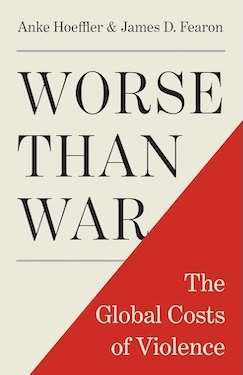
Worse than War: The Global Costs of Violence

ISBN

Publisher

Imprint

Year Published

Print Length

Format

SKU

9780691168890
Princeton University Press
N/A
2026
336 pages
Paperback
26396

Original price was: ₨9,895.00.Current price is: ₨1,695.00.

An empirically powerful account of why interpersonal violence across the globe exacts a far greater cumulative cost on society than war and terrorism combined

Description

Civil wars, interstate wars, and terrorism receive a great deal of media and policy attention, for good reasons. By contrast, the major forms of interpersonal violence—homicide, intimate partner violence, and severe physical punishment of children—generally have a much lower profile.

In Worse than War, Anke Hoeffler and James Fearon assemble and analyze the data on the global prevalence and costs of collective and interpersonal violence. They show that interpersonal violence is vastly more widespread and imposes far greater societal costs than collective violence. Wars tend to be concentrated in a small number of countries, and often relatively small areas within them. By contrast, almost all countries have rates of homicide and nonfatal assault, particularly of women and children, that far exceed the global average rates of death and injury in wars and terrorism.

Hoeffler and Fearon argue that high rates of interpersonal violence are not simply fixed by culture or other structural factors. Evidence from a host of program evaluations, natural experiments, and longer-term social movements make it clear that rates of homicide, intimate partner violence, and severe physical punishment of children can be reduced if they are effectively targeted. Interventions that promote peace in civil war–torn countries are also possible, but the opportunities are few and increasingly far between. Drawing on ideas and methods from many fields—economics, political science, public health, psychology, sociology, and others—the authors show that money and policy efforts directed toward reducing interpersonal violence thus merit higher priority both within countries and by international donors.

Praise and Reviews

“Worse than War is the most serious attempt I’ve seen to count the true global costs of violence. Hoeffler and Fearon show, with painstaking care, that the everyday violence in our homes and on our city streets dwarfs the toll of war. This will be the standard reference for anyone who wants to talk about ‘security’ and ‘development’ and actually mean it.”—Christopher Blattman, author of Why We Fight: The Roots of War and the Paths to Peace--------------------------- “Interpersonal violence is a neglected disease. This timely book provides a compelling analysis of its prevalence, costs, and treatment.”—Ron Smith, Birkbeck University of London---------------------------- “This book argues persuasively that more research and policy experimentation are needed to target interpersonal violence. The policy community must digest its ideas and take their implications seriously.”—Sir Tim Besley, London School of Economics and Political Science

About the Author

Anke Hoeffler is professor of development research at the University of Konstanz and the coauthor of Breaking the Conflict Trap. James D. Fearon is the Theodore and Frances Geballe Professor in the School of Humanities and Sciences and professor of political science at Stanford University.

Worse than War: The Global Costs of Violence

An empirically powerful account of why interpersonal violence across the globe exacts a far greater cumulative cost on society than war and terrorism combined

Description

Civil wars, interstate wars, and terrorism receive a great deal of media and policy attention, for good reasons. By contrast, the major forms of interpersonal violence—homicide, intimate partner violence, and severe physical punishment of children—generally have a much lower profile. In Worse than War, Anke Hoeffler and James Fearon assemble and analyze the data on the global prevalence and costs of collective and interpersonal violence. They show that interpersonal violence is vastly more widespread and imposes far greater societal costs than collective violence. Wars tend to be concentrated in a small number of countries, and often relatively small areas within them. By contrast, almost all countries have rates of homicide and nonfatal assault, particularly of women and children, that far exceed the global average rates of death and injury in wars and terrorism. Hoeffler and Fearon argue that high rates of interpersonal violence are not simply fixed by culture or other structural factors. Evidence from a host of program evaluations, natural experiments, and longer-term social movements make it clear that rates of homicide, intimate partner violence, and severe physical punishment of children can be reduced if they are effectively targeted. Interventions that promote peace in civil war–torn countries are also possible, but the opportunities are few and increasingly far between. Drawing on ideas and methods from many fields—economics, political science, public health, psychology, sociology, and others—the authors show that money and policy efforts directed toward reducing interpersonal violence thus merit higher priority both within countries and by international donors.

Praise and Reviews

“Worse than War is the most serious attempt I’ve seen to count the true global costs of violence. Hoeffler and Fearon show, with painstaking care, that the everyday violence in our homes and on our city streets dwarfs the toll of war. This will be the standard reference for anyone who wants to talk about ‘security’ and ‘development’ and actually mean it.”—Christopher Blattman, author of Why We Fight: The Roots of War and the Paths to Peace--------------------------- “Interpersonal violence is a neglected disease. This timely book provides a compelling analysis of its prevalence, costs, and treatment.”—Ron Smith, Birkbeck University of London---------------------------- “This book argues persuasively that more research and policy experimentation are needed to target interpersonal violence. The policy community must digest its ideas and take their implications seriously.”—Sir Tim Besley, London School of Economics and Political Science

About the Author

Anke Hoeffler is professor of development research at the University of Konstanz and the coauthor of Breaking the Conflict Trap. James D. Fearon is the Theodore and Frances Geballe Professor in the School of Humanities and Sciences and professor of political science at Stanford University.

Thank you. Your order has been received.

Please wait while redirecting to your order...