eCommerce WordPress Themes

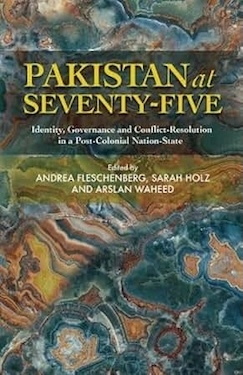
Pakistan at Seventy-Five: Identity, Governance and Conflict-Resolution in a Post-Colonial Nation-State

ISBN

Publisher

Imprint

Year Published

Print Length

Format

SKU

9781789761894
Liverpool University Press
N/A
2003
300 pages
Paperback
26547

Original price was: ₨18,200.00.Current price is: ₨1,395.00. 934.65

Description

Pakistan at Seventy-Five investigates the countrys multi-layered issues in the context of a post-colonial polity marked by diversity, heterogeneity, stratification and volatility. This wide-ranging discourse engages with diverse formal and informal actors as markers of identity, historical events and social conditions, as well as global geo-political and neo-colonial centreperiphery relations that shape narratives about the nation and the constructions of a sense of belonging. The editors and contributors utilise multi-faceted and multi-layered approaches, focusing on (1) identities, and questions of diversity and pluralism; (2) horizontal and vertical technologies and geographies of power related to questions of trust, legitimacy, participation, and governance; and (3) the distribution, deprivation and vulnerability of sociocultural, political, and human resources. Studying Pakistan has been subject to different approaches, including decolonial, indigenous, and feminist perspectives. This volume draws out alternative epistemological and methodological viewpoints: the insideroutsider conundrum, centreperiphery asymmetries, hegemonic discourses, and practices within Pakistans national/international academy. The chapter contributions are the outcome of a unique interdisciplinary research cooperation at Quaid-i-Azam University, focussing on early career researchers. Presenting a multiplicity of voices and trajectories, Pakistan at Seventy-Five provides new input to existing debates and directions for future scholarly endeavour. Contributors: Aftab Nasir, Andrea Fleschenberg, Arslan Waheed, Salman Rafi Sheikh, Sanaa Alimia, Sarah Holz, Sohaib Bodla, Wajeeha Tahir.

Praise and Reviews

‘One of the world’s most inegalitarian and unevenly developed societies, Pakistan remains in search of a viable nation-building project more than seven decades after coming into existence. This volume incisively captures logics of statecraft and accumulation in both centres and peripheries as well as the struggles of youth, working classes and academic-activists to forge a viable social contract and with it, a more just future.’ Aasim Sajjad Akhtar, Assistant Professor, Quaid-i-Azam University, Islamabad, Pakistan--------------------------------------- ‘This is a fascinating and brilliant collection of essays decentring knowledge production of the nation and state building in Pakistan. Illustrating a multi-level, multilayer matrix of knowledge production opening a multiplicity of voices and transversal and intersecting identities that are rarely heard in Pakistan. This is even more remarkable given the difficult research terrain that Pakistani social sciences finds itself in.’ Yunas Samad, Professor South Asian Studies / Director Political Science LUMS, Lahore, Pakistan, Emeritus Professor University of Bradford, UK

About the Author

Andrea Fleschenberg, Associate Professor, Institute for Asian and African Studies, Humboldt-Universitat zu Berlin, Germany. Sarah Holz, Interim Assistant Professor, Institute for Asian and African Studies, Humboldt-Universitat zu Berlin, Germany. Arslan Waheed, Assistant Professor, School of Social Sciences and Humanities, National University of Sciences and Technology, Islamabad, Pakistan.

Pakistan at Seventy-Five: Identity, Governance and Conflict-Resolution in a Post-Colonial Nation-State

Description

Pakistan at Seventy-Five investigates the countrys multi-layered issues in the context of a post-colonial polity marked by diversity, heterogeneity, stratification and volatility. This wide-ranging discourse engages with diverse formal and informal actors as markers of identity, historical events and social conditions, as well as global geo-political and neo-colonial centreperiphery relations that shape narratives about the nation and the constructions of a sense of belonging. The editors and contributors utilise multi-faceted and multi-layered approaches, focusing on (1) identities, and questions of diversity and pluralism; (2) horizontal and vertical technologies and geographies of power related to questions of trust, legitimacy, participation, and governance; and (3) the distribution, deprivation and vulnerability of sociocultural, political, and human resources. Studying Pakistan has been subject to different approaches, including decolonial, indigenous, and feminist perspectives. This volume draws out alternative epistemological and methodological viewpoints: the insideroutsider conundrum, centreperiphery asymmetries, hegemonic discourses, and practices within Pakistans national/international academy. The chapter contributions are the outcome of a unique interdisciplinary research cooperation at Quaid-i-Azam University, focussing on early career researchers. Presenting a multiplicity of voices and trajectories, Pakistan at Seventy-Five provides new input to existing debates and directions for future scholarly endeavour. Contributors: Aftab Nasir, Andrea Fleschenberg, Arslan Waheed, Salman Rafi Sheikh, Sanaa Alimia, Sarah Holz, Sohaib Bodla, Wajeeha Tahir.

Praise and Reviews

‘One of the world’s most inegalitarian and unevenly developed societies, Pakistan remains in search of a viable nation-building project more than seven decades after coming into existence. This volume incisively captures logics of statecraft and accumulation in both centres and peripheries as well as the struggles of youth, working classes and academic-activists to forge a viable social contract and with it, a more just future.’ Aasim Sajjad Akhtar, Assistant Professor, Quaid-i-Azam University, Islamabad, Pakistan--------------------------------------- ‘This is a fascinating and brilliant collection of essays decentring knowledge production of the nation and state building in Pakistan. Illustrating a multi-level, multilayer matrix of knowledge production opening a multiplicity of voices and transversal and intersecting identities that are rarely heard in Pakistan. This is even more remarkable given the difficult research terrain that Pakistani social sciences finds itself in.’ Yunas Samad, Professor South Asian Studies / Director Political Science LUMS, Lahore, Pakistan, Emeritus Professor University of Bradford, UK

About the Author

Andrea Fleschenberg, Associate Professor, Institute for Asian and African Studies, Humboldt-Universitat zu Berlin, Germany. Sarah Holz, Interim Assistant Professor, Institute for Asian and African Studies, Humboldt-Universitat zu Berlin, Germany. Arslan Waheed, Assistant Professor, School of Social Sciences and Humanities, National University of Sciences and Technology, Islamabad, Pakistan.

Thank you. Your order has been received.

Please wait while redirecting to your order...