eCommerce WordPress Themes

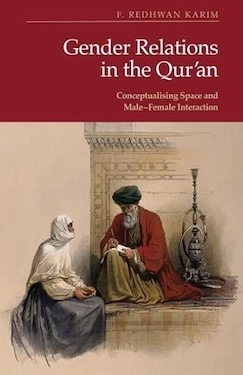
Gender Relations in the Qur’an: Conceptualising Space and Male–Female Interaction

ISBN

Publisher

Imprint

Year Published

Print Length

Format

SKU

9781399561341
Edinburgh University Press
N/A
2026
272 pages
Paperback
26506

Original price was: ₨33,600.00.Current price is: ₨1,495.00.

Description

A constricting attitude towards the relationship between non-maram (marriageable) men and women is often either politically enforced or self-imposed in Muslim societies, with notions of separation and segregation upheld as normative ideals. This book challenges such interpretations, delineating a more permissive and nuanced position rooted in the Qur’an. Responding to the oft-held notion of men occupying the public sphere while women are restricted to the private, the book explores whether the Qur’an adopts a conception of gendered space and gendered roles.

The book analyses the various forms of male–female interaction in the Qur’an, providing a comprehensive overview of gender relations and a critical dissection of restrictive readings. It also discusses clothing, offering a thorough overview of sartorial prescriptions in the Qur’an. Engaging with both classical and modern scholarship to provide a contextual reading, this book offers a comprehensive and expansive analysis of gender relations within a Qur’anic context.

Praise and Reviews

Redhwan Karim's analysis of gender relations in the Qur'an offers a finely argued challenge to canonical Muslim interpretations of some verses as incontrovertibly male-privileging. He makes interesting and original contributions, which can help recuperate the Qur'an’s universal ethical model for gender relationships. Hopefully, his book will be a powerful incentive for Muslims to do just that in their legal and moral reasoning. -- Asma Barlas, Ithaca College (Professor Emerita)------------------------------ This is a work of rigorous scholarship and analytical clarity. Through a careful engagement with the Qur’anic narrative, the author addresses the persistent question of whether the Qur’an mandates or assumes the seclusion of women. The result is an important and timely contribution to the study of gender in Islamic thought. This book is required read for anyone interested in what the Qur’an actually says about women’s participation in public life. -- Khaled Abou El Fadl, UCLA---------------------------------- A lucid and meticulously argued analysis of the Qur’an and foundational Islamic texts, Karim emphasizes female agency and probes overly restrictive interpretations of cross-gender interactions in Muslim sources. In addition to being a helpful classroom resource, the scholarship is valuable for specialists in gender studies and mandatory reading for those in positions of contemporary Islamic religious authority. -- Celene Ibrahim, Harvard University

About the Author

F. Redhwan Karim is Senior Lecturer in Islamic Studies and Course Leader for the BA Islamic Studies program at the Markfield Institute of Higher Education. He is the editor of History of the Qur’an: Approaches and Explorations (2024), and has published under peer-reviewed in the Journal of Islamic and Muslim Studies, ReOrient: The Journal of Critical Muslim Studies, The Muslim World Review and the Journal of Islamic Ethics.

Gender Relations in the Qur’an: Conceptualising Space and Male–Female Interaction

Description

A constricting attitude towards the relationship between non-maram (marriageable) men and women is often either politically enforced or self-imposed in Muslim societies, with notions of separation and segregation upheld as normative ideals. This book challenges such interpretations, delineating a more permissive and nuanced position rooted in the Qur’an. Responding to the oft-held notion of men occupying the public sphere while women are restricted to the private, the book explores whether the Qur’an adopts a conception of gendered space and gendered roles. The book analyses the various forms of male–female interaction in the Qur’an, providing a comprehensive overview of gender relations and a critical dissection of restrictive readings. It also discusses clothing, offering a thorough overview of sartorial prescriptions in the Qur’an. Engaging with both classical and modern scholarship to provide a contextual reading, this book offers a comprehensive and expansive analysis of gender relations within a Qur’anic context.

Praise and Reviews

Redhwan Karim's analysis of gender relations in the Qur'an offers a finely argued challenge to canonical Muslim interpretations of some verses as incontrovertibly male-privileging. He makes interesting and original contributions, which can help recuperate the Qur'an’s universal ethical model for gender relationships. Hopefully, his book will be a powerful incentive for Muslims to do just that in their legal and moral reasoning. -- Asma Barlas, Ithaca College (Professor Emerita)------------------------------ This is a work of rigorous scholarship and analytical clarity. Through a careful engagement with the Qur’anic narrative, the author addresses the persistent question of whether the Qur’an mandates or assumes the seclusion of women. The result is an important and timely contribution to the study of gender in Islamic thought. This book is required read for anyone interested in what the Qur’an actually says about women’s participation in public life. -- Khaled Abou El Fadl, UCLA---------------------------------- A lucid and meticulously argued analysis of the Qur’an and foundational Islamic texts, Karim emphasizes female agency and probes overly restrictive interpretations of cross-gender interactions in Muslim sources. In addition to being a helpful classroom resource, the scholarship is valuable for specialists in gender studies and mandatory reading for those in positions of contemporary Islamic religious authority. -- Celene Ibrahim, Harvard University

About the Author

F. Redhwan Karim is Senior Lecturer in Islamic Studies and Course Leader for the BA Islamic Studies program at the Markfield Institute of Higher Education. He is the editor of History of the Qur’an: Approaches and Explorations (2024), and has published under peer-reviewed in the Journal of Islamic and Muslim Studies, ReOrient: The Journal of Critical Muslim Studies, The Muslim World Review and the Journal of Islamic Ethics.

Thank you. Your order has been received.

Please wait while redirecting to your order...