eCommerce WordPress Themes
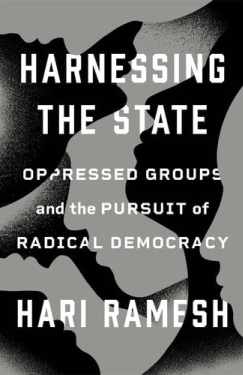
Harnessing the State - Oppressed Groups and the Pursuit of Radical Democracy

Harnessing the State: Oppressed Groups and the Pursuit of Radical Democracy

ISBN

Publisher

Imprint

Year Published

Print Length

Format

SKU

9780674293618
Harvard University Press
N/A
2026
272 pages
Paperback
26749

Original price was: ₨11,000.00.Current price is: ₨1,500.00.

Building on the work of key twentieth-century US and Indian thinkers, a bold argument that oppressed groups can―and should―make use of state power to create truly democratic societies.

Description

Group-based social oppression, along lines such as caste in India and race in the United States, is a persistent problem in nominally democratic countries. Unsurprisingly, many citizens are skeptical that the state can effectively address the problem. Pro-democracy scholars and activists often argue that the state is just a tool of society’s most powerful interests, who will stifle any attempted reform.

Yet some of the twentieth century’s most significant political thinkers offer a more hopeful and fruitful perspective. Foregrounding previously neglected connections between Indian and American sources, Hari Ramesh draws on insights from John Dewey, B. R. Ambedkar, W. E. B. Du Bois, and a key brief from Brown v. Board of Education to argue that oppressed groups can in fact wield the tools of the state to claim agency and dismantle the sources of their oppression. In this alternative account, state action fosters a radical vision of democracy, with citizens coming together as equals to formulate and pursue their political aims.

Group-based social oppression is not only unjust: by selectively preventing citizens from participating fully and equally in the project of self-government, oppression undermines the possibility of democracy itself. Harnessing the State shows a way forward.

Praise and Reviews

“Harnessing the State puts to rest the idea that radical democracy and state authority are fundamentally opposed. Hari Ramesh’s beautifully argued and politically urgent study shows how John Dewey, B. R. Ambedkar, W. E. B. Du Bois, and the legal team behind Brown v. Board of Education reconceived the relationship of citizens and the state to challenge group-based oppression. At a time when official cruelty is intensifying and liberal democratic institutions are under assault, Ramesh reminds us why the struggle for an egalitarian future requires creatively reimagining the work of the state.”―Lawrie Balfour, author of Democracy's Reconstruction--------------------------------- “Hari Ramesh reorients democratic theory by showing that oppressed groups can convert the very institutions long implicated in their subordination into levers for transforming the social relations that undermine collective self-government. By placing Dewey, Ambedkar, Du Bois, and the architects of Brown in a shared conceptual frame, Harnessing the State demonstrates that radical democracy emerges not from rejecting the state but from channeling its capacities through the experiences, knowledge, and agency of the oppressed. In this way, it offers a new philosophical account of democratic action―one that locates the possibility of egalitarian transformation at the intersection of structural injustice, institutional power, and the creative political initiatives of marginalized citizens. This is a superlative book.”―Melvin L. Rogers, author of The Darkened Light of Faith------------------------------ “Harnessing the State is an accomplished work on a central question of democratic theory. Using Dewey’s notion of ‘democratic association’ as its central insight, Hari Ramesh skillfully weaves together a forceful argument that in democratic states there is always a third option that is sharply different from either accepting suboptimal outcomes of democratic processes or seeking to overthrow democratic institutions. His analysis deftly joins theoretical arguments with the concrete work of detailed juridical craftsmanship to reveal startling examples―in India and in the US―where the most marginalized groups have been able to use the powers of the modern state for ameliorative social change. This is an important work in democratic theory for its subtle readings of intellectual history and its complex analysis of democratic activism.”―Sudipta Kaviraj, author of The Imaginary Institution of India

About the Author

Hari Ramesh is Assistant Professor of Government at Wesleyan University.

Harnessing the State: Oppressed Groups and the Pursuit of Radical Democracy

Building on the work of key twentieth-century US and Indian thinkers, a bold argument that oppressed groups can―and should―make use of state power to create truly democratic societies.

Description

Group-based social oppression, along lines such as caste in India and race in the United States, is a persistent problem in nominally democratic countries. Unsurprisingly, many citizens are skeptical that the state can effectively address the problem. Pro-democracy scholars and activists often argue that the state is just a tool of society’s most powerful interests, who will stifle any attempted reform. Yet some of the twentieth century’s most significant political thinkers offer a more hopeful and fruitful perspective. Foregrounding previously neglected connections between Indian and American sources, Hari Ramesh draws on insights from John Dewey, B. R. Ambedkar, W. E. B. Du Bois, and a key brief from Brown v. Board of Education to argue that oppressed groups can in fact wield the tools of the state to claim agency and dismantle the sources of their oppression. In this alternative account, state action fosters a radical vision of democracy, with citizens coming together as equals to formulate and pursue their political aims. Group-based social oppression is not only unjust: by selectively preventing citizens from participating fully and equally in the project of self-government, oppression undermines the possibility of democracy itself. Harnessing the State shows a way forward.

Praise and Reviews

“Harnessing the State puts to rest the idea that radical democracy and state authority are fundamentally opposed. Hari Ramesh’s beautifully argued and politically urgent study shows how John Dewey, B. R. Ambedkar, W. E. B. Du Bois, and the legal team behind Brown v. Board of Education reconceived the relationship of citizens and the state to challenge group-based oppression. At a time when official cruelty is intensifying and liberal democratic institutions are under assault, Ramesh reminds us why the struggle for an egalitarian future requires creatively reimagining the work of the state.”―Lawrie Balfour, author of Democracy's Reconstruction--------------------------------- “Hari Ramesh reorients democratic theory by showing that oppressed groups can convert the very institutions long implicated in their subordination into levers for transforming the social relations that undermine collective self-government. By placing Dewey, Ambedkar, Du Bois, and the architects of Brown in a shared conceptual frame, Harnessing the State demonstrates that radical democracy emerges not from rejecting the state but from channeling its capacities through the experiences, knowledge, and agency of the oppressed. In this way, it offers a new philosophical account of democratic action―one that locates the possibility of egalitarian transformation at the intersection of structural injustice, institutional power, and the creative political initiatives of marginalized citizens. This is a superlative book.”―Melvin L. Rogers, author of The Darkened Light of Faith------------------------------ “Harnessing the State is an accomplished work on a central question of democratic theory. Using Dewey’s notion of ‘democratic association’ as its central insight, Hari Ramesh skillfully weaves together a forceful argument that in democratic states there is always a third option that is sharply different from either accepting suboptimal outcomes of democratic processes or seeking to overthrow democratic institutions. His analysis deftly joins theoretical arguments with the concrete work of detailed juridical craftsmanship to reveal startling examples―in India and in the US―where the most marginalized groups have been able to use the powers of the modern state for ameliorative social change. This is an important work in democratic theory for its subtle readings of intellectual history and its complex analysis of democratic activism.”―Sudipta Kaviraj, author of The Imaginary Institution of India

About the Author

Hari Ramesh is Assistant Professor of Government at Wesleyan University.

Thank you. Your order has been received.

Please wait while redirecting to your order...