eCommerce WordPress Themes
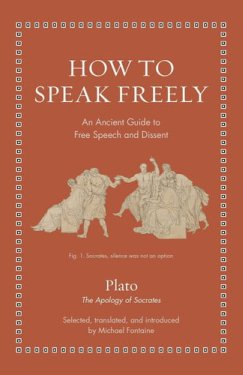
How to speak freely: an ancient guide to free speech and dissent

How to Speak Freely: An Ancient Guide to Free Speech and Dissent

ISBN

Publisher

Imprint

Year Published

Print Length

Format

SKU

9780691271460
Princeton University Press
N/A
2026
216 pages
Paperback
26900

Original price was: ₨5,300.00.Current price is: ₨1,395.00.

A vivid and timely new translation of Plato’s Apology, in which Socrates defends his pursuit of truth, no matter the consequences

Description

Free speech is back at the center of political and cultural debate, amid intense arguments over censorship on campus, in government, and in everyday life. How to Speak Freely offers a timeless and essential exploration of free speech through a lively new translation of Plato’s Apology, perhaps the most famous and important work on the subject in all of Western history. In it, Plato recounts the trial of Socrates in 399 BCE—one of the most powerful defenses of freedom of thought and speech ever written.

In Plato’s Apology, Socrates embodies the archetype of a person who thinks independently: a figure of conviction who pursued curiosity honestly, became convinced of unpopular truths, spoke candidly about them, and refused to grovel, pander, or recant—even to save his life. By insisting on his freedom and accepting the consequences, Socrates became the most famous martyr to free inquiry in history—and raised enduring questions about the value, dangers, and limits of free speech in a democracy.

How to Speak Freely supplements Plato’s Apology with a delightful fable on free speech told from a different angle. In the short dialogue The Gods in Council, Lucian (c. 125–180 CE) satirizes the concept of “platforming,” showing how free speech ideals are truly tested only when they’re truly applied.

Featuring an enlightening introduction and the original Greek on facing pages, How to Speak Freely is a powerful and thought-provoking examination of the rewards and risks of speaking one’s mind.

Praise and Reviews

"With illuminating commentary and facing-page Greek, this elegant volume reminds us that free speech has always carried both a price and a provocation." ― Indulge Magazine

About the Author

Plato (427–347 BCE) is the Greek philosopher par excellence: the disciple of Socrates, teacher of Aristotle, and intellectual ancestor of the West. His dialogues, which take the form of dramatic conversations between actual historical figures, explore justice, ethics, politics, and metaphysics, and they champion reason over authority or revelation. Michael Fontaine is professor of classics and director of the Program on Freedom and Free Societies at Cornell University. His books include five other volumes in the Ancient Wisdom for Modern Readers series, How to Drink, How to Grieve, How to Tell a Joke, How to Have Willpower, and How to Get Over a Breakup (all Princeton).

How to Speak Freely: An Ancient Guide to Free Speech and Dissent

A vivid and timely new translation of Plato’s Apology, in which Socrates defends his pursuit of truth, no matter the consequences

Description

Free speech is back at the center of political and cultural debate, amid intense arguments over censorship on campus, in government, and in everyday life. How to Speak Freely offers a timeless and essential exploration of free speech through a lively new translation of Plato’s Apology, perhaps the most famous and important work on the subject in all of Western history. In it, Plato recounts the trial of Socrates in 399 BCE—one of the most powerful defenses of freedom of thought and speech ever written. In Plato’s Apology, Socrates embodies the archetype of a person who thinks independently: a figure of conviction who pursued curiosity honestly, became convinced of unpopular truths, spoke candidly about them, and refused to grovel, pander, or recant—even to save his life. By insisting on his freedom and accepting the consequences, Socrates became the most famous martyr to free inquiry in history—and raised enduring questions about the value, dangers, and limits of free speech in a democracy. How to Speak Freely supplements Plato’s Apology with a delightful fable on free speech told from a different angle. In the short dialogue The Gods in Council, Lucian (c. 125–180 CE) satirizes the concept of “platforming,” showing how free speech ideals are truly tested only when they’re truly applied. Featuring an enlightening introduction and the original Greek on facing pages, How to Speak Freely is a powerful and thought-provoking examination of the rewards and risks of speaking one’s mind.

Praise and Reviews

"With illuminating commentary and facing-page Greek, this elegant volume reminds us that free speech has always carried both a price and a provocation." ― Indulge Magazine

About the Author

Plato (427–347 BCE) is the Greek philosopher par excellence: the disciple of Socrates, teacher of Aristotle, and intellectual ancestor of the West. His dialogues, which take the form of dramatic conversations between actual historical figures, explore justice, ethics, politics, and metaphysics, and they champion reason over authority or revelation. Michael Fontaine is professor of classics and director of the Program on Freedom and Free Societies at Cornell University. His books include five other volumes in the Ancient Wisdom for Modern Readers series, How to Drink, How to Grieve, How to Tell a Joke, How to Have Willpower, and How to Get Over a Breakup (all Princeton).

Thank you. Your order has been received.

Please wait while redirecting to your order...