
₨6,400.00 Original price was: ₨6,400.00.₨1,395.00Current price is: ₨1,395.00.
₨9,150.00 Original price was: ₨9,150.00.₨1,595.00Current price is: ₨1,595.00.
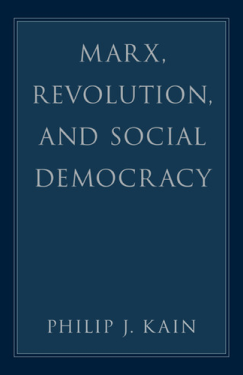
Marx, Revolution, and Social Democracy
ISBN
Publisher
Imprint
Year Published
Print Length
Format
SKU
₨24,950.00 Original price was: ₨24,950.00.₨1,495.00Current price is: ₨1,495.00.
Marx wasn’t a totalitarian dreamer—he was a social democrat whose ideas shaped Western Europe’s most successful political tradition.
This book proves it with four arguments that demolish the false choice between utopian fantasy and Soviet nightmare.
Description
Many people think Marx a totalitarian and Soviet Marxism the predictable outcome of his thought. If one shows them the texts-proves to them that Marx was a radical democrat–they often flip and think him utopian. Totalitarian or utopian–for many those seem to be the alternatives. How might one combat this completely mistaken image?
To establish the connection between Marx and social democracy, philosopher Philip J. Kain argues four main points. First, economy if markets are controlled to eliminate alienation, socialist society for Marx is compatible with a market. Second, markets can be controlled democratically. Third, Marx had a theory of revolution compatible with a democratic electoral movement engaged in by a social democratic party. And fourth, from the late 1860s on, Marx and Engels worked with the German Social Democratic Party of Liebknecht, Bebel, Bernstein, and Kautsky–which eventually became the largest party in Germany and the largest socialist party in the world.
If social democracy is a true expression of Marxism, then Marx cannot be called a totalitarian. There is nothing remotely totalitarian about social democracy. Nor is it utopian. It exists all over Western Europe. Moreover, social democratic parties have always opposed the undemocratic tactics of Soviet Marxism. Drawing on these four points, Kain argues against the depiction of Marx as either utopian or totalitarian, and instead makes a case for Marx as a social democrat, whose strongest legacy is found in Western Europe.
Praise and Reviews
About the Author
Philip Joseph Kain is an American philosopher and Professor of Philosophy Emeritus at Santa Clara University. He is known for his works on post-Kantian philosophy.
Source: Wikipedia, CC BY-SA.
Marx, Revolution, and Social Democracy
Marx wasn’t a totalitarian dreamer—he was a social democrat whose ideas shaped Western Europe’s most successful political tradition.
This book proves it with four arguments that demolish the false choice between utopian fantasy and Soviet nightmare.
Description
Praise and Reviews
About the Author
Philip Joseph Kain is an American philosopher and Professor of Philosophy Emeritus at Santa Clara University. He is known for his works on post-Kantian philosophy.
Source: Wikipedia, CC BY-SA.