
₨5,850.00 Original price was: ₨5,850.00.₨1,350.00Current price is: ₨1,350.00.


₨3,995.00 Original price was: ₨3,995.00.₨1,795.00Current price is: ₨1,795.00.
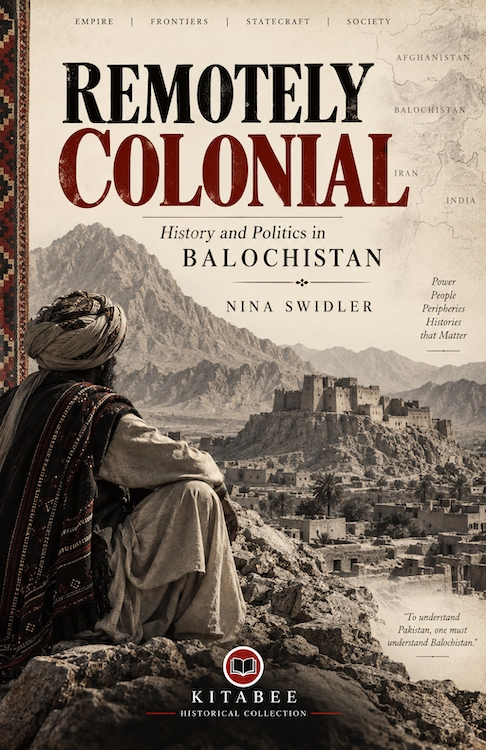
REMOTELY COLONIAL: History and Politics in BALOCHISTAN
ISBN
Publisher
Imprint
Year Published
Print Length
Format
SKU
₨1,795.00
Description
For centuries, Balochistan has occupied a distinctive place in the political and historical landscape of South Asia. Its vast geography, diverse communities, tribal structures, and strategic location have shaped the ways in which outside powers sought to understand and govern the region. This work explores the complex relationship between colonial authority and local society, offering a deeper look at how political power developed in a distant and often misunderstood frontier.
Drawing on history and political analysis, the narrative examines the ways colonial policies influenced administration, tribal leadership, political identities, and relations between the centre and the periphery. It highlights the tensions that emerged when external systems of governance encountered established local institutions and traditions, revealing the lasting consequences of these encounters.
The study also places Balochistan within the wider context of colonial South Asia, showing how questions of territory, authority, identity, and political representation became intertwined over time. By examining both historical developments and their political implications, it encourages readers to look beyond simplified accounts of the region and consider the deeper forces that have shaped its modern history.
Published by Kitabee, this insightful work will appeal to readers interested in Balochistan, colonial history, South Asian politics, anthropology, and the evolution of political institutions. With its focus on the relationship between distant authority and local realities, it provides a valuable perspective on a region whose history continues to play an important role in understanding the politics of South Asia.
Praise and Reviews
About the Author
REMOTELY COLONIAL: History and Politics in BALOCHISTAN
Description
For centuries, Balochistan has occupied a distinctive place in the political and historical landscape of South Asia. Its vast geography, diverse communities, tribal structures, and strategic location have shaped the ways in which outside powers sought to understand and govern the region. This work explores the complex relationship between colonial authority and local society, offering a deeper look at how political power developed in a distant and often misunderstood frontier.
Drawing on history and political analysis, the narrative examines the ways colonial policies influenced administration, tribal leadership, political identities, and relations between the centre and the periphery. It highlights the tensions that emerged when external systems of governance encountered established local institutions and traditions, revealing the lasting consequences of these encounters.
The study also places Balochistan within the wider context of colonial South Asia, showing how questions of territory, authority, identity, and political representation became intertwined over time. By examining both historical developments and their political implications, it encourages readers to look beyond simplified accounts of the region and consider the deeper forces that have shaped its modern history.
Published by Kitabee, this insightful work will appeal to readers interested in Balochistan, colonial history, South Asian politics, anthropology, and the evolution of political institutions. With its focus on the relationship between distant authority and local realities, it provides a valuable perspective on a region whose history continues to play an important role in understanding the politics of South Asia.