eCommerce WordPress Themes

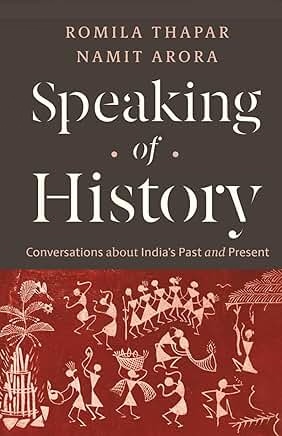
Speaking of History: Conversations about India’s Past and Present

ISBN

Publisher

Imprint

Year Published

Print Length

Format

SKU

9789383968473
Three Essays Collective
N/A
2025
290 pages
Paperback
hlkyf

Original price was: ₨4,000.00.Current price is: ₨1,500.00.

Speaking of History brings India’s past into sharp, urgent focus. In these wide-ranging conversations, Romila Thapar, the distinguished historian, joins Namit Arora, incisive writer and social critic, to explore how history is written, remembered and fought over.

Description

Together, they pull back the curtain on the historian’s craft: how evidence is weighed, how interpretations are made, and why the past has become a battleground of politics and identity. From caste and gender to religion, mythology and nationalism, they revisit much contested terrain and ask the vital questions—what can we really know about our past, and why does it matter so much today?

The result is both erudite and refreshingly accessible: a book that challenges distortion and mythmaking, while celebrating history as an act of curiosity, argument and critical inquiry. At a time when the discipline is under siege, Speaking of History is both a defence of rigorous scholarship and a lively reminder that to engage with history in all its complexity is to undertake a profound journey—an inquiry not just into the past, but into ourselves.

(Published in the Indian subcontinent by Penguin Random House India, elsewhere by Three Essays Collective.)

Praise and Reviews

'A far-reaching conversation [that] translates complex academic arguments into clear, readable prose without flattening their nuance, helping readers understand why history continues to be a site of intense political and cultural struggle in the present. A must-read in these times of contested histories and post-truth anomalies.' —Rashmi Vasudeva, Deccan Herald------------------------------------ 'The book's chief strength lies in its dialogic format. Thapar speaks—with patience, erudition, and plainspoken clarity, occasionally spiced with wry humour ... Arora is the ideal interlocutor and foil, posing questions that are informed, judicious, and occasionally mildly provocative' —Jayanta Sengupta, The Telegraph------------------------------------ 'In Speaking of History, Thapar and Arora discuss a wide range of issues pertaining to history and history-writing, and talk about the perils of being a historian at a time when there is a fierce onslaught on the discipline ... an engaging and lively discussion.' —Prof. Amar Farooqui, The Wire------------------------------------ 'The conversations ... have a double focus. First, they warn us against the widespread tendency to distort history to create a largely false narrative about India's past, and the great harm such distortions will do to India's present and future. Second, the conversations identify the thematic matrix for a proper understanding of Indian history'. —Prof. Salil Mishra, The Tribune------------------------------------ 'I loved this book because it took me back to scholarship and academic discourse in a manner that did not remind me of my college textbooks and research papers. It discussed subjects, methods and approaches that I have myself formally studied, and was grappling to revisit and re-interpret through the prism of current narratives.' —Jasodhara Banerjee, Forbes India------------------------------------ 'यह बातचीत चौबीस मुद्दों पर केंद्रित है. इसमें नमित ने कोई सवाल भर नहीं पूछा है बल्कि वे अपनी टिप्पणियों से पाठक और इतिहासकार रोमिला थापर को थोड़ा बेचैन करते चलते हैं. उधर रोमिला थापर अपनी विशेषज्ञता को थोड़ा नरम कर उसे सामान्य पाठकों के लिए सुलभ बनाती हैं. यह बातचीत एक खास शिल्प में की गई है जिससे पाठकों को श्रोता होने का बोध भी हासिल होता है ... इसे सभी को पढ़ना चाहिए.' —रमाशंकर सिंह, India Today Hindi------------------------------------ [Explores] 'why history is misunderstood and the perils of learning about the past from WhatsApp forwards... [the] conversation flows nice and easy and myths are busted regularly'. —Ziya Us Salam, The Hindu (review)------------------------------------ 'In an era where history is a weapon, this book stands tall as both shield and sword for critical thinking, challenging us to embrace complexity over comforting fictions ... Essential reading that doesn't just inform—it equips you to argue back.' —Swapna Peri, Storizen Magazine------------------------------------ 'If there is one message from this book of deep and intelligent conversations between Romila Thapar and Namit Arora, it is to rationally question everything. This is a book worth reading and engaging with, for the depth with which it covers such a large gamut of topics.' —Sushant Singh, X

About the Author

ROMILA THAPAR is emeritus professor of history at Jawaharlal Nehru University, New Delhi. She is a fellow of the British Academy and holds an Hon D.Litt each from the University of Calcutta, University of Oxford and the University of Chicago. In 2008, Thapar was awarded the prestigious Kluge Prize of the US Library of Congress for Lifetime Achievement in the Humanities and Social Sciences. She has authored over twenty-five books. NAMIT ARORA is a writer, social critic and the author of three previous books, including Indians and The Lottery of Birth. Trained in science and technology, he has spent over three decades educating himself in the humanities, history and other social sciences. His recent work of public history is a ten-part web series, Indians: A Brief History of a Civilization.

Speaking of History: Conversations about India’s Past and Present

Speaking of History brings India’s past into sharp, urgent focus. In these wide-ranging conversations, Romila Thapar, the distinguished historian, joins Namit Arora, incisive writer and social critic, to explore how history is written, remembered and fought over.

Description

Together, they pull back the curtain on the historian’s craft: how evidence is weighed, how interpretations are made, and why the past has become a battleground of politics and identity. From caste and gender to religion, mythology and nationalism, they revisit much contested terrain and ask the vital questions—what can we really know about our past, and why does it matter so much today? The result is both erudite and refreshingly accessible: a book that challenges distortion and mythmaking, while celebrating history as an act of curiosity, argument and critical inquiry. At a time when the discipline is under siege, Speaking of History is both a defence of rigorous scholarship and a lively reminder that to engage with history in all its complexity is to undertake a profound journey—an inquiry not just into the past, but into ourselves. (Published in the Indian subcontinent by Penguin Random House India, elsewhere by Three Essays Collective.)

Praise and Reviews

'A far-reaching conversation [that] translates complex academic arguments into clear, readable prose without flattening their nuance, helping readers understand why history continues to be a site of intense political and cultural struggle in the present. A must-read in these times of contested histories and post-truth anomalies.' —Rashmi Vasudeva, Deccan Herald------------------------------------ 'The book's chief strength lies in its dialogic format. Thapar speaks—with patience, erudition, and plainspoken clarity, occasionally spiced with wry humour ... Arora is the ideal interlocutor and foil, posing questions that are informed, judicious, and occasionally mildly provocative' —Jayanta Sengupta, The Telegraph------------------------------------ 'In Speaking of History, Thapar and Arora discuss a wide range of issues pertaining to history and history-writing, and talk about the perils of being a historian at a time when there is a fierce onslaught on the discipline ... an engaging and lively discussion.' —Prof. Amar Farooqui, The Wire------------------------------------ 'The conversations ... have a double focus. First, they warn us against the widespread tendency to distort history to create a largely false narrative about India's past, and the great harm such distortions will do to India's present and future. Second, the conversations identify the thematic matrix for a proper understanding of Indian history'. —Prof. Salil Mishra, The Tribune------------------------------------ 'I loved this book because it took me back to scholarship and academic discourse in a manner that did not remind me of my college textbooks and research papers. It discussed subjects, methods and approaches that I have myself formally studied, and was grappling to revisit and re-interpret through the prism of current narratives.' —Jasodhara Banerjee, Forbes India------------------------------------ 'यह बातचीत चौबीस मुद्दों पर केंद्रित है. इसमें नमित ने कोई सवाल भर नहीं पूछा है बल्कि वे अपनी टिप्पणियों से पाठक और इतिहासकार रोमिला थापर को थोड़ा बेचैन करते चलते हैं. उधर रोमिला थापर अपनी विशेषज्ञता को थोड़ा नरम कर उसे सामान्य पाठकों के लिए सुलभ बनाती हैं. यह बातचीत एक खास शिल्प में की गई है जिससे पाठकों को श्रोता होने का बोध भी हासिल होता है ... इसे सभी को पढ़ना चाहिए.' —रमाशंकर सिंह, India Today Hindi------------------------------------ [Explores] 'why history is misunderstood and the perils of learning about the past from WhatsApp forwards... [the] conversation flows nice and easy and myths are busted regularly'. —Ziya Us Salam, The Hindu (review)------------------------------------ 'In an era where history is a weapon, this book stands tall as both shield and sword for critical thinking, challenging us to embrace complexity over comforting fictions ... Essential reading that doesn't just inform—it equips you to argue back.' —Swapna Peri, Storizen Magazine------------------------------------ 'If there is one message from this book of deep and intelligent conversations between Romila Thapar and Namit Arora, it is to rationally question everything. This is a book worth reading and engaging with, for the depth with which it covers such a large gamut of topics.' —Sushant Singh, X

About the Author

ROMILA THAPAR is emeritus professor of history at Jawaharlal Nehru University, New Delhi. She is a fellow of the British Academy and holds an Hon D.Litt each from the University of Calcutta, University of Oxford and the University of Chicago. In 2008, Thapar was awarded the prestigious Kluge Prize of the US Library of Congress for Lifetime Achievement in the Humanities and Social Sciences. She has authored over twenty-five books. NAMIT ARORA is a writer, social critic and the author of three previous books, including Indians and The Lottery of Birth. Trained in science and technology, he has spent over three decades educating himself in the humanities, history and other social sciences. His recent work of public history is a ten-part web series, Indians: A Brief History of a Civilization.

Thank you. Your order has been received.

Please wait while redirecting to your order...