eCommerce WordPress Themes

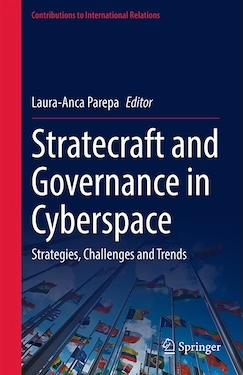
Statecraft and Governance in Cyberspace: Strategies, Challenges and Trends

ISBN

Publisher

Imprint

Year Published

Print Length

Format

SKU

9789819583409
Springer
N/A
2026
344 pages
Paperback
26293

Original price was: ₨34,000.00.Current price is: ₨2,995.00.

Description

This edited volume examines two concepts that are central to contemporary interactions in cyberspace: statecraft and governance, showing how they interact and reinforce each other in complex ways. By emphasising the role of cyberspace as both an arena of competition and a strategic tool in geopolitical rivalries, the contributions included in this volume shed light on how states utilise cyber capabilities to project influence, protect their strategic autonomy, and navigate the complex interplay of cooperation and conflict. The volume also addresses ongoing collective efforts to regulate cyberspace across institutions and regions, as well as the moral, societal and cognitive implications of digital transformations for states and societies. Combining theoretical perspectives with empirical case studies, this edited volume contributes to a deeper understanding of the strategies states use in geopolitical competition, the challenges they face, and the complexities that characterise modern international relations in cyberspace.

Chapter 2 and 9 are available open access under a Creative Commons Attribution 4.0 International License via link.springer.com.

Praise and Reviews

This edited volume examines two concepts that are central to contemporary interactions in cyberspace: statecraft and governance, showing how they interact and reinforce each other in complex ways. By emphasising the role of cyberspace as both an arena of competition and a strategic tool in geopolitical rivalries, the contributions included in this volume shed light on how states utilise cyber capabilities to project influence, protect their strategic autonomy, and navigate the complex interplay of cooperation and conflict. The volume also addresses ongoing collective efforts to regulate cyberspace across institutions and regions, as well as the moral, societal and cognitive implications of digital transformations for states and societies. Combining theoretical perspectives with empirical case studies, this edited volume contributes to a deeper understanding of the strategies states use in geopolitical competition, the challenges they face, and the complexities that characterise modern international relations in cyberspace.

About the Author

Laura-Anca Parepa is an Associate Professor at the Graduate School of Global Studies, Doshisha University and a Visiting Research Fellow at the Research Institute for Policy Studies, Tsuda University. She holds a PhD in International Public Policy from Tsukuba University, where her research focused on civil-military relations in Asia, especially China. Before starting her academic career, Parepa worked in defence cooperation and diplomacy, as well as in the international private sector. Her research interests include civil-military relations, cyber and economic statecraft, emerging forms of warfare, defence and security policies, and frameworks for international security cooperation. Among her recent publications are “Managing the People’s Liberation Army”(in State Capacity Building in Contemporary China, 2020) and “The Belt and Road Initiative as Continuity in Chinese Foreign Policy”(Journal of Contemporary East Asia Studies, 2020).

Statecraft and Governance in Cyberspace: Strategies, Challenges and Trends

Description

This edited volume examines two concepts that are central to contemporary interactions in cyberspace: statecraft and governance, showing how they interact and reinforce each other in complex ways. By emphasising the role of cyberspace as both an arena of competition and a strategic tool in geopolitical rivalries, the contributions included in this volume shed light on how states utilise cyber capabilities to project influence, protect their strategic autonomy, and navigate the complex interplay of cooperation and conflict. The volume also addresses ongoing collective efforts to regulate cyberspace across institutions and regions, as well as the moral, societal and cognitive implications of digital transformations for states and societies. Combining theoretical perspectives with empirical case studies, this edited volume contributes to a deeper understanding of the strategies states use in geopolitical competition, the challenges they face, and the complexities that characterise modern international relations in cyberspace. Chapter 2 and 9 are available open access under a Creative Commons Attribution 4.0 International License via link.springer.com.

Praise and Reviews

This edited volume examines two concepts that are central to contemporary interactions in cyberspace: statecraft and governance, showing how they interact and reinforce each other in complex ways. By emphasising the role of cyberspace as both an arena of competition and a strategic tool in geopolitical rivalries, the contributions included in this volume shed light on how states utilise cyber capabilities to project influence, protect their strategic autonomy, and navigate the complex interplay of cooperation and conflict. The volume also addresses ongoing collective efforts to regulate cyberspace across institutions and regions, as well as the moral, societal and cognitive implications of digital transformations for states and societies. Combining theoretical perspectives with empirical case studies, this edited volume contributes to a deeper understanding of the strategies states use in geopolitical competition, the challenges they face, and the complexities that characterise modern international relations in cyberspace.

About the Author

Laura-Anca Parepa is an Associate Professor at the Graduate School of Global Studies, Doshisha University and a Visiting Research Fellow at the Research Institute for Policy Studies, Tsuda University. She holds a PhD in International Public Policy from Tsukuba University, where her research focused on civil-military relations in Asia, especially China. Before starting her academic career, Parepa worked in defence cooperation and diplomacy, as well as in the international private sector. Her research interests include civil-military relations, cyber and economic statecraft, emerging forms of warfare, defence and security policies, and frameworks for international security cooperation. Among her recent publications are “Managing the People’s Liberation Army”(in State Capacity Building in Contemporary China, 2020) and “The Belt and Road Initiative as Continuity in Chinese Foreign Policy”(Journal of Contemporary East Asia Studies, 2020).

Thank you. Your order has been received.

Please wait while redirecting to your order...