
₨10,600.00 Original price was: ₨10,600.00.₨3,650.00Current price is: ₨3,650.00.


₨12,500.00 Original price was: ₨12,500.00.₨1,595.00Current price is: ₨1,595.00.
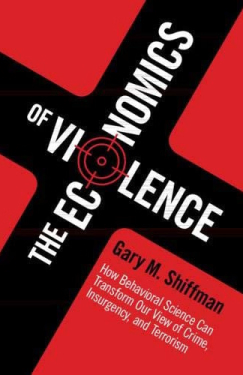
The Economics of Violence How Behavioral Science Can Transform our View of Crime, Insurgency, and Terrorism
ISBN
Publisher
Imprint
Year Published
Print Length
Format
SKU
₨7,250.00 Original price was: ₨7,250.00.₨1,395.00Current price is: ₨1,395.00.
Violence is predictable. By understanding it through behavioral science and economics, we can design institutions and policies that actually prevent it—and build lasting security.
Description
How do we understand illicit violence? Can we prevent it? Building on behavioral science and economics, this book begins with the idea that humans are more predictable than we like to believe, and this ability to model human behavior applies equally well to leaders of violent and coercive organizations as it does to everyday people. Humans ultimately seek survival for themselves and their communities in a world of competition. While the dynamics of ‘us vs. them’ are divisive, they also help us to survive. Access to increasingly larger markets, facilitated through digital communications and social media, creates more transnational opportunities for deception, coercion, and violence. If the economist’s perspective helps to explain violence, then it must also facilitate insights into promoting peace and security. If we can approach violence as behavioral scientists, then we can also better structure our institutions to create policies that make the world a more secure place, for us and for future generations.
Praise and Reviews
About the Author
The Economics of Violence How Behavioral Science Can Transform our View of Crime, Insurgency, and Terrorism
Violence is predictable. By understanding it through behavioral science and economics, we can design institutions and policies that actually prevent it—and build lasting security.