eCommerce WordPress Themes

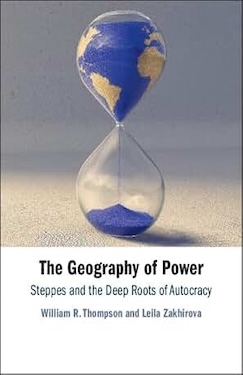
The Geography of Power: Steppes and the Deep Roots of Autocracy

ISBN

Publisher

Imprint

Year Published

Print Length

Format

SKU

9781009783774
Cambridge University Press
N/A
2026
300 pages
Paperback
26696

Original price was: ₨15,250.00.Current price is: ₨1,695.00.

Description

Why are most contemporary autocracies concentrated between Siberia and Central Africa, while other regions remain largely democratic? This book uncovers the deep historical forces behind that divide, tracing how geography – particularly the vast steppe grasslands – and political–economic conflicts between nomadic and sedentary societies shaped enduring patterns of power. These structured conflicts reinforced authoritarian persistence across half the globe, creating a binary world with starkly different opportunities and threats. The result is a long-standing geopolitical fault line that continues to shape global politics today, exemplified by the autocratic axis of China, Russia, Iran, and North Korea. Combining insights from geography, history, and political economy, this book offers a compelling explanation of why authoritarianism thrives – and why democracy prevails elsewhere.

Praise and Reviews

Thompson and Zakhirova build upon their novel observation regarding the geographic distribution of authoritarianism, refusing simple explanations, and providing a master class on assembling important insights from half a dozen academic fields.' Robert A. Denemark, Department of Political Science, University of Delaware--------------------------------- ‘This is a magisterial world-historical synopsis of research and theorizing about the long-term causes of autocratic regimes. Long exposure to threats from nomadic steppe confederacies lay the tracks for centralized autocratic regimes necessary for defense that become ensconced along steppe frontiers. The authors also examine the role that differences in regime types between democracies and autocracies play in past and contemporary struggles for global power. This has important implications for what is likely to happen in the rest of the 21st century.' Christopher Chase-Dunn, Department of Sociology, University of California-Riverside

About the Author

William R. Thompson is Distinguished Professor and Rogers Chair of Political Science Emeritus in the Department of Political Science at Indiana University. Leila Zakhirova is Chair and Professor in the Political Science Department at Concordia College.

The Geography of Power: Steppes and the Deep Roots of Autocracy

Description

Why are most contemporary autocracies concentrated between Siberia and Central Africa, while other regions remain largely democratic? This book uncovers the deep historical forces behind that divide, tracing how geography – particularly the vast steppe grasslands – and political–economic conflicts between nomadic and sedentary societies shaped enduring patterns of power. These structured conflicts reinforced authoritarian persistence across half the globe, creating a binary world with starkly different opportunities and threats. The result is a long-standing geopolitical fault line that continues to shape global politics today, exemplified by the autocratic axis of China, Russia, Iran, and North Korea. Combining insights from geography, history, and political economy, this book offers a compelling explanation of why authoritarianism thrives – and why democracy prevails elsewhere.

Praise and Reviews

Thompson and Zakhirova build upon their novel observation regarding the geographic distribution of authoritarianism, refusing simple explanations, and providing a master class on assembling important insights from half a dozen academic fields.' Robert A. Denemark, Department of Political Science, University of Delaware--------------------------------- ‘This is a magisterial world-historical synopsis of research and theorizing about the long-term causes of autocratic regimes. Long exposure to threats from nomadic steppe confederacies lay the tracks for centralized autocratic regimes necessary for defense that become ensconced along steppe frontiers. The authors also examine the role that differences in regime types between democracies and autocracies play in past and contemporary struggles for global power. This has important implications for what is likely to happen in the rest of the 21st century.' Christopher Chase-Dunn, Department of Sociology, University of California-Riverside

About the Author

William R. Thompson is Distinguished Professor and Rogers Chair of Political Science Emeritus in the Department of Political Science at Indiana University. Leila Zakhirova is Chair and Professor in the Political Science Department at Concordia College.

Thank you. Your order has been received.

Please wait while redirecting to your order...