
₨8,650.00 Original price was: ₨8,650.00.₨1,495.00Current price is: ₨1,495.00.


₨8,900.00 Original price was: ₨8,900.00.₨1,495.00Current price is: ₨1,495.00.
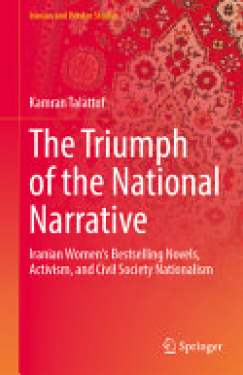
The Triumph of the National Narrative
ISBN
Publisher
Imprint
Year Published
Print Length
Format
SKU
₨41,950.00 Original price was: ₨41,950.00.₨2,295.00Current price is: ₨2,295.00.
This book examines the long history of women’s resistance and struggle against the Islamic Republic’s tyranny, by analyzing women’s literary works from the early 2000s onwards.
Description
This book examines the long history of women’s resistance and struggle against the Islamic Republic’s tyranny, by analyzing women’s literary works from the early 2000s onwards. It explores the social and urban conditions that facilitated the rise of what the civil society literary movement, showing how these novels built upon earlier feminist and reformist writings as well as political activism to revive the country’s national narrative – one that had been under attack by the ideological- utopian-revolutionary narratives since the early decades the Pahlavi’s dynasty. Since the establishment of the Islamic Republic in Iran after the 1979 Revolution, which began its rule by limiting social and political freedom, mandating the veil, crushing freedom of expression, and suppressing oppositional activities, Iranians have resisted and fought back under various pretexts and political approaches. The book shows how its women, in particular, have carried a heavier burden because their rights were more radically curtailed. The author shows that they were inspired by a variety of social approaches — including feminist perspectives, civil society ideals, and nationalist aspirations – all of which they have helped shape and advance, especially during the ‘Women, Life, Freedom’ (WLF) movement. Throughout this struggle, the collective memory of past social progress helped propel it forward, making the desire for a civil society a national project, where the past meets the future. Iranian women have produced an oeuvre of literary works to explain their situation, limitations, and aspirations, and have returned to the streets many times to question the very existence of the regime. This book analyses their narratives of protest, and recovers and elevates texts largely dismissed by mainstream literary critics, making a case for their aesthetic and political importance. It offers a new theoretical model for analyzing literature in authoritarian contexts, through the Iranian example. Relevant to feminist literary scholars and gender theorists, particularly those focused on the Middle East, this is a timely, vital work on how Iranian women have served, and continue to maintain, a message of emancipation.
Praise and Reviews
About the Author
Kamran Talattof is the Elahé Omidyar Mir-Djalali Chair in Persian and Iranian studies at the University of Arizona.
Source: Wikipedia, CC BY-SA.
The Triumph of the National Narrative
This book examines the long history of women’s resistance and struggle against the Islamic Republic’s tyranny, by analyzing women’s literary works from the early 2000s onwards.
Description
Praise and Reviews
About the Author
Kamran Talattof is the Elahé Omidyar Mir-Djalali Chair in Persian and Iranian studies at the University of Arizona.
Source: Wikipedia, CC BY-SA.